Showing posts with label cuts. Show all posts

Tuesday, 1 September 2015

Summer houses on the NHS? Cutting through the news reports with questions for our CCGs!


Sky News led its bulletin this morning with attention-grabbing headlines about summer houses, holidays and sat-navs being funded by the NHS. Sky News didn't actually research the story themselves - that was done by Pulse magazine, which investigated how personal healthcare budgets are spent. Plenty of other media outlets have also run this story including the BBC, the Mirror,

At least the Guardian, the Telegraph and the Independent mentioned that it is Clinical Commissioning Groups - or CCGs - that are allocating the money courtesy of the personal healthcare budgets. That would be the CCGs created under the Health and Social Care Act 2012. But you'd sooner find a report about the colonisation of the moon by unicorns wearing saddles made of cheese than ever see a news report mention this act, which was passed in the last parliament by the Conservative and Liberal Democrat MPs.

Of course, the truth is rather more complicated than any of these reports imply. Credit where credit is due though - the Daily Mail, while not accepting comments on the article online, had the insight to run a decent Press Association report. This report featured an interview with a professor who pointed out that while personal healthcare budgets may seem attractive on the surface, they do reflect an ideology that is "consumerist and individualistic" and not evidence-based.

But the way this story has been largely reported serves insidious dual purposes.

1. It demonises patients in the same way that stories about misuse of A&E departments and GPs demonise patients. While misuse of A&E and GP services creates problems, it makes for cheap headlines that ignore the bigger funding issues. It is easier to mock the person who rocked up to A&E with dog poo on their shoe than get properly angry about things like the cost to the taxpayer of rotten PFI deals and administering the NHS marketplace, both of which squander billions of pounds each year.

While personal healthcare budgets are not compulsory, can we be sure that patients, especially vulnerable and elderly patients, are not pressured into joining this scheme? It has echoes of Jeremy Hunt's plan to put the price of medications on the packaging so we know how much we are costing the NHS every time we take a pill that we need to get better. This plays into the "mustn't be a burden" mentality, the fear of wasting NHS time, even if someone is in genuine need of care.

If these budgets are targeting the vulnerable, it becomes questionable as to whether they really meet the goal of helping people take responsibility for their health and wellbeing.

2. It is more NHS-bashing by the media, feeding into the public appetite for cuts. By highlighting summer houses, holidays and sat-navs, it makes people angry about profligate NHS spending and removes any subtlety from the discussion. A holistic approach to healthcare is important - and defenders of personal healthcare budgets will use this argument - but holistic treatments need to be evidence-based, especially when they are publicly funded.

Are personal healthcare budgets a sneaky way to funnel more money to the private sector right under our noses? Will patients be encouraged to use their budgets to fund private health insurance?

The Pulse report does not mention our local CCGs, which fall under the umbrella of South West London Collaborative Commissioning. But in the interests of full transparency, we have some questions for them about how they use personal healthcare budgets. As we are still fighting to keep essential services, such as A&E and maternity as well as entire hospitals open, these questions need to be answered.

If a representative from SWLCC could respond to the following questions in the comments section of this blog post, that would be much appreciated:

1. How many patients in the CCGs which come under SWLCC's administration are on personal healthcare budgets?

2. What is the average amount spent per patient on these budgets?

3. Can you provide a demographic breakdown of who uses these budgets?

4. Without naming patients, is there information available on what sort of treatments these budgets are funding?

5. What happens to a patient if their personal budget runs out and their health has not improved?


Monday, 29 June 2015

The £219m promise for St Helier Hospital...


It was an intriguing exchange in the House of Commons when George Osborne filled in for David Cameron at Prime Minister's Question Time and Tom Brake asked him about funding for much-needed upgrades to St Helier Hospital.

Here is the exchange from Hansard:

Tom Brake (Carshalton and Wallington) (LD): The Chancellor will be aware that under the coalition, £219 million was allocated to rebuilding St Helier hospital. Will he restate the commitment to that funding so that we can save St Helier?
Mr Osborne: We did commit to that hospital project, and provided that it continues to represent value for money, which I am pretty clear that it does, we will go on providing that support. What we have done is to commit to the Simon Stevens plan for the national health service—an additional £8 billion of NHS spending —which is something we can only do if we have our public finances in better order and we are growing our economy, which is precisely what we are doing.
In response to George Osborne's rather mealy-mouthed answer, Tom Brake put out the following press release:
Chancellor George Osborne promised that the new government would allocate £219 million to save St. Helier Hospital. He was challenged directly by Tom Brake, MP for Carshalton and Wallington, during Prime Minister’s Questions on Wednesday. 
Mr. Osborne pledged to provide funding for St. Helier as long as the hospital “continues to represent value for money.” He said he thinks the hospital is performing well now.
Tom has led a campaign to save St. Helier hospital from harmful budget cuts for years. More than 21,000 local residents have signed his online petition to save the hospital, which can be found at http://www.saveoursthelier.co.uk/save_our_st_helier_petition.
Tom commented,
“I am pleased that Mr. Osborne has promised to stick with the coalition government’s plan to allocate £219 million to St. Helier Hospital. I intend to hold him to his promise. Our community deserves convenient access to essential healthcare services from a quality hospital like St. Helier. Osborne and the Conservative government must now deliver it.”
Tom Brake (Carshalton and Wallington) (LD): The Chancellor will be aware that under the coalition, £219 million was allocated to rebuilding St Helier hospital. Will he restate the commitment to that funding so that we can save St Helier?
Mr Osborne: We did commit to that hospital project, and provided that it continues to represent value for money, which I am pretty clear that it does, we will go on providing that support. What we have done is to commit to the Simon Stevens plan for the national health service—an additional £8 billion of NHS spending —which is something we can only do if we have our public finances in better order and we are growing our economy, which is precisely what we are doing.
Hang on a moment, Tom. Where exactly in George Osborne's response does he actually say the £219m is back on the table? He doesn't. He gives a slippery politician's answer.
Tom, a few things...
1. The £219m was taken off the table in February 2014, as we are sure you are aware.
2. How does this claim that the £219m is promised for St Helier Hospital square up with the £360m in "efficiency savings" that the CCGs are making? The numbers simply do not add up.
3. The CCGs hold the pursestrings here and both you and Mr Osborne voted for the Health and Social Care Act 2012, the very act that created the CCGs. So why are neither of you mentioning the CCGs?
4. Are you putting pressure on the CCGs to rethink the need for the £360m in "efficiency savings"?
5. Given that the Health and Social Care Act 2012 takes responsibility for the NHS away from the Secretary of State for Health and places it in the hands of the CCGs, does George Osborne or Jeremy Hunt have the authority to make promises about funding for individual hospitals?
6. Why are you still linking to your e-petition about St Helier Hospital when it is still addressed to the wrong body, pre-dates the election and nobody seems to know when it will be handed in?
We eagerly await your response, Mr Brake.


Sunday, 21 June 2015

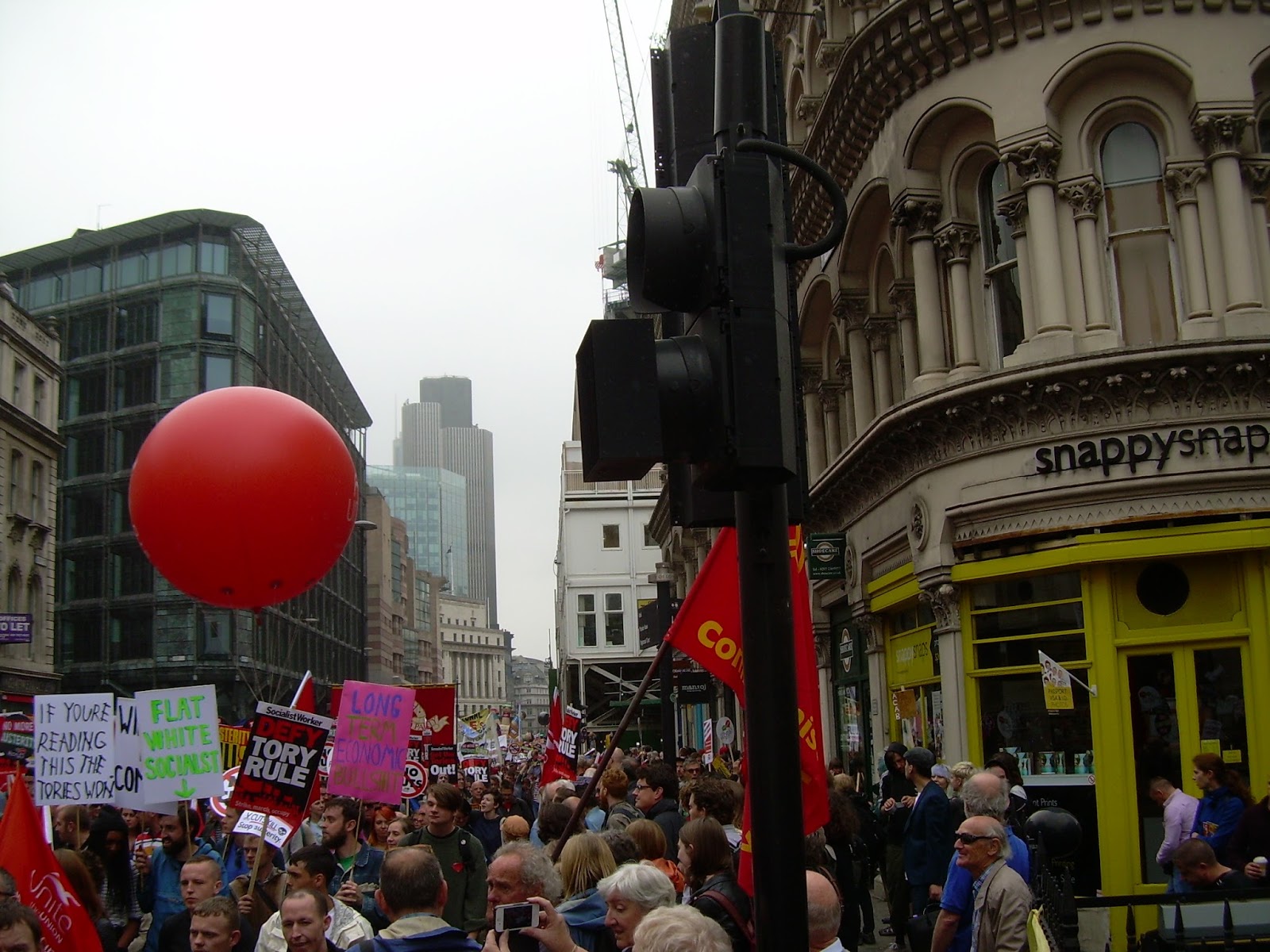
Keep Our St Helier Hospital campaigners take to the streets of London!


KOSHH campaigner, Colin Crilly, reports on the peaceful anti-austerity march held in London on Saturday 20 June:

The anti-austerity march in Central London was huge. Estimates of the number of people marching were as high as 200,000 in the media. Amongst these people, there was a high number of NHS campaigners.

KOSHH campaigners, Brian Hennessy, Saleh Mamon and myself represented our campaign. We took turns holding up the KOSHH banner throughout the march. We were able to link up with other NHS campaigners, such as the Lambeth Keep Our NHS Public group. During the march, prominent campaigner and editor of NHS SOS, Dr Jacky Davis took my photo.


 When I arrived at Parliament Square, I saw a fire engine. Sure enough, Steve, who let us use the fire engine for a protest in Sutton last year, was at the wheel. He sent his regards to all KOSHH campaigners and gave me his number in case we want to use the fire engine in future actions.

The rally had high profile speakers, including: Charlotte Church, Owen Jones, Caroline Lucas, Jeremy Corbyn and Russell Brand. At the finale, the crowd was encouraged to go into their communities to continue working hard and spreading the word.


Here are some more photos from the march.


On Wednesday July 8, there will be a further protest against an emergency budget from George Osborne - that is sure to bring more worrying news for our health services. Click here for more information.

Click here to order a copy of Dr Jacky Davis and Raymond Tallis's book, NHS SOS.