Showing posts with label KOSHH. Show all posts

Sunday, 25 October 2015

Why you should be in Balham this Tuesday night


KOSHH campaigner Colin Crilly writes about why everyone who cares about the NHS should attend a public meeting this Tuesday night (27 October) at 7.30pm in Balham: 

If you believe all that you read and see in the media, you would be forgiven for thinking that the NHS is on its last legs, and no longer fit for purpose. However, there is a much bigger story going on, one that is nearly all but being ignored by our news papers and television: The privatisation of our health service.

St George's Hospital (Tooting) is facing huge financial problems, mental health services in Queen Mary's (Roehampton) are being cut, and now St Helier (Carshalton) and Epsom Hospitals are facing the real threat of being demolished. These cases are just the latest in a pattern that has gone on for the last 30 years or so, regardless of what party happens to be in power.

The fact is that a state-run health service is the most efficient health service. All of the layers of bureaucracy that have been introduced, as well as companies coming in with a profit-before-care agenda, have left our health service in the poor state that we see today. 


We also have the legacy of the appalling debts from PFI (Private Finance Initiative) contracts. These contracts come with outrageous levels of interest that will take decades to pay back. In real terms, government investment in our NHS has been reduced for some time. Beware, we are heading towards a US-style health insurance system.

If you are concerned about these issues, want to find out more, and would like to help save our hospitals and health services, we urge you to attend our public meeting on Tuesday 27 October. The venue is the Balham Baptist Church, 21 Ramsden Rd, SW12 8QX and the meeting starts at 7.30pm.


Click here for more information. 

Tuesday, 20 October 2015

KOSHH campaigners stand with junior doctors


KOSHH campaigners joined the junior doctors who marched in London on Saturday.

Here is a video from the march:


And here are some junior doctors share their experiences and explain why they are demanding negotiations with Health Secretary, Jeremy Hunt, over the grossly unfair junior doctors' contract:


KOSHH fully supports junior doctors as they fight for a fairer deal. The proposals from the Health Secretary will endanger patient safety and lead to the UK losing more doctors as they seek better, safer working conditions in other countries.


Thursday, 17 September 2015

Handy tips for journalists reporting on NHS stories


The standard of reporting on stories in the mainstream British media about the NHS is frequently lazy, inaccurate, incomplete or just poor. We received a terrific response to our blog post on 1 September about the terrible reporting across multiple media outlets on personal health budgets. We do not expect the standard of reporting on NHS stories to improve any time soon so we have put together some helpful tips for journalists who report on the NHS.

1. "NHS bosses" is a lazy term constantly used by journalists. While the term is OK for a headline where space is tight and the attention of readers needs to be grabbed, it is too vague for proper reporting. Within a report, the journalist should always clarify exactly who the "NHS bosses" are. Do they mean hospital trusts? Clinical commissioning groups? Simon Stevens? Jeremy Hunt? Chances are, the reporter is referring to either trusts or CCGs. This needs to be made clear from the outset.

2. When reporters for national newspapers and news channels are referring to trusts and CCGs when they talk of "NHS bosses", it needs to be made clear that these bodies make different decisions in different areas. The way stories such as the personal health budgets funding "treats" and the NHS funding gluten-free food were reported in recent weeks seldom made it clear that these funding decisions vary wildly between areas. Instead, we ended up with a warped narrative that made it sound like the NHS was morphing into a giant, nationwide hybrid of Greggs and Butlins.

3. It is important that readers and viewers are aware of what CCGs actually are. As NHS campaigners, we need to keep in mind that not everyone understands what a CCG is or the powers they have to make massive decisions about our vital health services - they are making decisions on everything from gluten-free food and IVF to hospital cuts and closures.

4. We realise that it can be hard to explain what a CCG is in every single media report. However, for journalists whose work appears online, it is easy to provide links to pages that can explain what CCGs are. Despite the limitations of broadcast time or space in print media, even a brief one-liner to explain CCGs would be helpful.

5. CCGs are just one outcome of the Health and Social Care Act 2012. If you are reporting on the NHS, you have the responsibility of reading this act as it has shaped the NHS as we know it today. If you are interviewing an MP who voted for this act, ask them if they regret voting for the act. Ask them if they take responsibility for any negative outcomes that can be directly attributed to this act.

6. When you are reporting about something that has gone wrong in the NHS, it should not be used as a stick with which to beat the entire NHS or a rallying cry to close down entire hospitals. When something goes wrong, it should be an opportunity for improvement, for ensuring that "never incidents" never happen again. Find out what trusts and CCGs are doing to make improvements if something goes wrong and hold them to account. If people are killed or injured, they should not be seen as collateral damage, as a reason to cut services.

7. When something goes wrong in the NHS, investigate properly. Find out if any private companies may have been involved. If there is an outbreak of infection in a hospital, for example, find out if the cleaning has been contracted out to the private sector, ask about the cleaning company's training procedures and how well their employees are paid. Is the incident related to staff shortages? Is the trust relying heavily on agency staff? Are patients receiving inconsistent care because of a lack of permanent staff?

8. It is especially important to find out about the extent of private company involvement in the NHS, especially when things go wrong or if CCGs and trusts are spending our money on private management consultancy firms. Unfortunately, private companies are exempt from FOI requests. This makes it hard to properly report on the NHS. This is quite deliberate, a conscious attempt to reduce transparency and keep people unaware.

You can and should make FOI requests of CCGs and trusts in relation to their private sector partners. You might not get a complete answer because of commercial confidentiality, but this should be noted in your report. You should also ask the private companies involved for comment whenever it is relevant and note in your report if they refuse to comment or did not return phonecalls or reply to emails.

9. Attend CCG and trust board meetings, especially if you work in the local media. They are open to the public. They are where big decisions are made and hard questions should be asked. Such meetings are usually held during working hours so it is difficult for many people to attend. The media has a responsibility to attend such meetings and report on what is said. This should be seen by local and regional journalists as being as important as attending council meetings.

10. Find out about vested interests, especially on CCGs. Clinical commissioning groups, as the name suggest, commission services, they spend our money. If CCG members have vested interests in private healthcare providers, they should not be commissioning health services. If you are reporting on a CCG, find out if their declared interests have been published online. If not, call them out on it.

11. Ask local campaigners for comment. We are always happy to talk to the media, may have good information from meetings we have attended, such as CCG meetings, and might offer you perspectives that you had not previously considered.

Does anyone have any more tips for good reporting on the NHS? Please feel free to leave them in the comments section below.

Tuesday, 15 September 2015

SAVE THE DATE! KOSHH pub quiz! Thursday 1 October!


KOSHH is holding a pub quiz to raise awareness about our campaign and funds to help us spread the word and fight to keep our local hospitals open.

We always have a lot of fun at our pub quizzes and the quiz mistress is already busy setting the questions - as always, there will be questions for everyone with topics ranging from pop culture to history to completely random facts.

Spread the word! Bring friends and family! And if you can donate a prize, please get in touch with us either in the comments, via Twitter @Save_St_Helier or on our Facebook page.

Date: Thursday 1 October.

Time: 7.30pm for an 8pm kick-off.

Venue: Morden Brook Pub, Lower Morden Lane, Morden. SM4 4SS.

Cost: Gold coin donation per player.

Public transport directions: From Morden Tube Station, catch the 163, 293 or 413 from Bus Stop F. If you are on the 163 or 293, get off the bus at the eighth stop (Lower Morden/The Beverley). If you are on the 413, get off the bus at the 10th stop (Queen Mary Avenue).

From Raynes Park Station, catch the 163 towards Morden from Bus Stop S and get off at either Queen Mary Avenue (six stops) or Tudor Drive (seven stops).

From Sutton Town Centre, catch the 413 to Queen Mary Avenue (14 stops from Times Square, Stop J).

From Epsom Town Centre, catch the 293 bus from Stop C or Stop G (Epsom High Street) and get off at the Tudor Drive stop (22-23 stops).


Photography by George Hodan

Thursday, 3 September 2015

Update on personal health budgets in South-West London/Surrey


We received an excellent response to our blog post on personal health budgets, the poor media reporting of these budgets and what they may mean for health services in our area. Thank you to everyone who took the time to read the blog post and share it.

We have now put in freedom of information requests with all six Clinical Commissioning Groups responsible for our end of South-West London/Surrey.

These are the questions they have been asked:

1. How many patients in the CCGs which come under SWLCC's administration are on personal healthcare budgets?

2. What is the average amount spent per patient on these budgets?

3. Can you provide a demographic breakdown of who uses these budgets?

4. Without naming patients, is there information available on what sort of treatments these budgets are funding?

5. What happens to a patient if their personal budget runs out and their health has not improved?


The six CCGs have 20 working days to respond to the FOI request. As such, we will report back on September 29 on any responses we have received.

Tuesday, 1 September 2015

Summer houses on the NHS? Cutting through the news reports with questions for our CCGs!


Sky News led its bulletin this morning with attention-grabbing headlines about summer houses, holidays and sat-navs being funded by the NHS. Sky News didn't actually research the story themselves - that was done by Pulse magazine, which investigated how personal healthcare budgets are spent. Plenty of other media outlets have also run this story including the BBC, the Mirror,

At least the Guardian, the Telegraph and the Independent mentioned that it is Clinical Commissioning Groups - or CCGs - that are allocating the money courtesy of the personal healthcare budgets. That would be the CCGs created under the Health and Social Care Act 2012. But you'd sooner find a report about the colonisation of the moon by unicorns wearing saddles made of cheese than ever see a news report mention this act, which was passed in the last parliament by the Conservative and Liberal Democrat MPs.

Of course, the truth is rather more complicated than any of these reports imply. Credit where credit is due though - the Daily Mail, while not accepting comments on the article online, had the insight to run a decent Press Association report. This report featured an interview with a professor who pointed out that while personal healthcare budgets may seem attractive on the surface, they do reflect an ideology that is "consumerist and individualistic" and not evidence-based.

But the way this story has been largely reported serves insidious dual purposes.

1. It demonises patients in the same way that stories about misuse of A&E departments and GPs demonise patients. While misuse of A&E and GP services creates problems, it makes for cheap headlines that ignore the bigger funding issues. It is easier to mock the person who rocked up to A&E with dog poo on their shoe than get properly angry about things like the cost to the taxpayer of rotten PFI deals and administering the NHS marketplace, both of which squander billions of pounds each year.

While personal healthcare budgets are not compulsory, can we be sure that patients, especially vulnerable and elderly patients, are not pressured into joining this scheme? It has echoes of Jeremy Hunt's plan to put the price of medications on the packaging so we know how much we are costing the NHS every time we take a pill that we need to get better. This plays into the "mustn't be a burden" mentality, the fear of wasting NHS time, even if someone is in genuine need of care.

If these budgets are targeting the vulnerable, it becomes questionable as to whether they really meet the goal of helping people take responsibility for their health and wellbeing.

2. It is more NHS-bashing by the media, feeding into the public appetite for cuts. By highlighting summer houses, holidays and sat-navs, it makes people angry about profligate NHS spending and removes any subtlety from the discussion. A holistic approach to healthcare is important - and defenders of personal healthcare budgets will use this argument - but holistic treatments need to be evidence-based, especially when they are publicly funded.

Are personal healthcare budgets a sneaky way to funnel more money to the private sector right under our noses? Will patients be encouraged to use their budgets to fund private health insurance?

The Pulse report does not mention our local CCGs, which fall under the umbrella of South West London Collaborative Commissioning. But in the interests of full transparency, we have some questions for them about how they use personal healthcare budgets. As we are still fighting to keep essential services, such as A&E and maternity as well as entire hospitals open, these questions need to be answered.

If a representative from SWLCC could respond to the following questions in the comments section of this blog post, that would be much appreciated:

1. How many patients in the CCGs which come under SWLCC's administration are on personal healthcare budgets?

2. What is the average amount spent per patient on these budgets?

3. Can you provide a demographic breakdown of who uses these budgets?

4. Without naming patients, is there information available on what sort of treatments these budgets are funding?

5. What happens to a patient if their personal budget runs out and their health has not improved?


Thursday, 30 July 2015

Asking questions of the Epsom-St Helier Trust, Part I


Yesterday, we informed the public that the Epsom-St Helier Trust's Estates Review document is not a benign document about mere bricks and mortar. It is about the very future of our local hospitals.

KOSHH campaigners are systematically going through the document and we have already started asking questions of the trust via our Twitter account about the review, the consultation process and how it will be publicised. We are disappointed that our local MPs and councillors are not publicly scrutinising the Estates Review or asking questions of the trust on behalf of the people who use Epsom and St Helier's NHS hospitals.

Today, multiple campaigners have asked the trust questions about the online questionnaire process attached to the Estates Review and how widely this will be publicised.

Questions from Twitter, Wednesday 30 July, 2015

The trust confirmed yesterday that the online questionnaire would be open until September 30. Here are some more questions from KOSHH campaigners and answers from the Epsom-St Helier Trust from today:

Q: Can you tell me the purpose of seeking views on the estates document? What is the objective?

A: Simply to find out what local people want from hospital buildings and facilities in the future.

This answer doesn't really tell us much. Surely local people want to continue to receive healthcare services from hospital buildings and facilities and for these buildings and facilities to be properly maintained so they are hygienic and safe?

So we asked another question...

Q: That's *what* you intend to discover. My question is why? For what purpose?

A: Do you think it might be best to have a conversation about this? We can organise a chat with one of our execs. Easier for you and us to share info that way!

We are finding it perfectly easy to ask questions via social media. We like the open forum, we like that the public can see the answers as we receive them. We will continue to ask questions about the Estates Review publicly in the interests of transparency.

The Epsom-St Helier Trust has expressed reservations about answering our questions via the 140-character format of Twitter. We agree that this has its limitations. With that in mind, we invite the trust to use the comments section of this blog if they would like to answer our concerns with more than 140 characters. This blog is set up so anyone from anywhere in the world can comment.

Raising public awareness about the Estates Review

KOSHH campaigners are deeply concerned about how widely publicised the Estates Review and the online questionnaire will be. We are quite sure that very few members of the wider public are aware of this review or that they can download the document and give their feedback to the trust. As such, we asked the following questions:

Q: Will you make the general public aware of this questionnaire about their local hospital? Do you want a wide response to the questions? Will you publicise it?

A: We'd love a wide response! Have asked GPs, councils, Healthwatch and community groups to take part.

Q: What about people outside of those groups?

A: We've been promoting it on the web, Twitter, public meetings and leaflet will be with us shortly!

Waiting for more answers

As yet, we have not received a direct answer from the trust on these questions:

Q: What will be done with the information garnered via the online questionnaire?

Q: In regard to the promised leaflets, how will they be distributed? Mailed out to all residents?

As soon as we have responses to these questions, we will share them via Twitter, Facebook and this blog. Spokespeople for the Epsom-St Helier Trust are more than welcome to respond to these questions in the comments section of this blog post.

We look forward to getting more answers as we carefully analyse the Estates Review document and we will share the answers as we receive them.


Photography by Charles Rondeau

KOSHH campaigner in the news!

It has never been easier to write to your local newspaper in this era of email. And with newspapers now online, the reach of newspapers goes beyond the traditional audience of people who actually buy newspapers or have them delivered. We urge everyone to be heard via the letters pages of our newspapers - it does not take long to send an email.

KOSHH campaigner, Philippa Maslin, features at the top of the letters page in today's Sutton Guardian. She expresses perfectly our frustrations with our MPs and the conflicting messages thet are sending out over the future of Epsom and St Helier Hospitals.


Wednesday, 29 July 2015

The Epsom-St Helier Trust Estates Review: This is not a drill! This is the future of our hospitals!


The Epsom-St Helier Trust has released the Estates Review document. At first glance, it seems like a harmless enough report on the bricks and mortar of our local hospitals. It might even be a bit boring.

But the reality is that the Estates Review document is rather serious indeed. It is a report on the future of our local hospitals, Epsom and St Helier. We cannot underestimate the importance of this document or the need for people to read it carefully and respond to it.

Click here for the link to the report. You will have to download a PDF of the report to find out what the findings are and what this might mean for our vital health services.

At the end of the link is a questionnaire so members of the public can respond to the Estates Review. The Epsom-St Helier Trust has assured us this is not the official public consultation. We should hope not - this has been released with minimal publicity over the summer holiday period when many people are away. The closing date for submitting your comments via the online questionnaire is Wednesday 30 September.

We would be horrified if this was the official consultation period and the process was just an online questionnaire, given that the report could provide a road map for the future of our hospitals.

KOSHH campaigners will be reading the Estates Review document very carefully as we have serious concerns about what it contents mean for the future of our hospitals. Rest assured that as we go through this document, we will be asking hard questions of the Epsom-St Helier Trust and we will be making our questions and their responses public. 

Monday, 27 July 2015

KOSHH goes to the pub!


KOSHH campaigner, Colin Crilly writes about yesterday's stall at the Morden Brook:

On the afternoon of Sunday 26 July, KOSHH had a stall at the Morden Brook pub*, as part of their event to raise funds for the Great Ormond Street Hospital. I was joined by Sandra Ash, David Ash and Dave Ash - we nicknamed ourselves CASH!**

We leafleted most people in the pub about the screening of Sell-Off, which will be held this Wednesday night. Click here for more information about the screening - this will also be held at the Morden Brook.
We also got a few more petition signatures, which are always welcome. Additionally, more badges were sold, and we gave out quite a few KOSHH window posters. Click here for more information about how to get your hands on one of these lovely posters. 

After more than three hours, we packed up, and posted the remaining leaflets about the Sell-Off screening through letterboxes of a nearby street. As I left the pub, I met a lady by the name of Sandra, and gave her a leaflet - it turned out that she is a leading figure at the nearby church. She has promised to attend the screening and inform other members of the congregation about it. We have also been invited to be part of the church's open day in September.

Any actions like these, no matter how small, are always worthwhile. Every leaflet given out, or discussion participated in could be of pivotal importance. It all helps to get the message out that not only are our local health services under threat but also the wider NHS.


* Many thanks to the Morden Brook for their ongoing support with meeting rooms and event-hosting. Click here to "like" them on Facebook.

** Many thanks to Philippa Zielfa Maslin and Chris Stanton for their assistance in dropping off some essentials to the stall as well.


Thursday, 23 July 2015

KOSHH raises awareness at the Morden Family Fun Day

Dave Ash, Philippa Maslin and Colin Crilly spread the word about the threat to our hospital.


KOSHH campaigner Philippa Maslin writes about our presence on the weekend at the Morden Family Fun Day, an annual event held in Morden Park.

Sunday 19 July 2015 was the Morden Family Fun Day and KOSHH were extremely pleased to be a part of it. Thank you very much to Andy Butcher for his help in making this happen.

The KOSHH stall drew a lot of attention throughout the day, with many people interested to know the latest news regarding the hospital, and to sign a petition addressed to South West London Collaborative Commissioning (SWLCC). This petition asks that SWLCC protects, maintains and improves not only St Helier Hospital, but also Epsom Hospital, St George’s Hospital, Kingston Hospital and Croydon Hospital. 

In addition, quite a few people donated £1 in exchange for a lovely KOSHH badge, and ‘a regular’ at St Helier Hospital bought one of our equally lovely T-shirts.

People who were born at the hospital, people whose children were born at the hospital, people who have attended A&E, people whose life was saved by hospital staff, and people who are regular patients – we met them all and, by gosh, did some of them have some moving stories to tell. It was clear that the local community’s high regard for and loyalty to the hospital remains undiminished, and that ongoing threats to the hospital are perceived as deeply unjust.

It was particularly notable that a number of visitors to the stall recalled a BBC London news report, from April, which unearthed a secret plan to replace St Helier Hospital and Epsom Hospital with a new medical centre in Sutton – a centre which would not be built until at least 2020, but which would have just 800 beds, as opposed to the current 1,200 beds. 

What was especially striking was that no one seemed to be aware of the Estates Review being conducted by the Trust, or that the Review’s recommendation that £500m needs to be spent on rebuilding St Helier Hospital and St Epsom Hospital stands in direct contradiction to the massive ‘efficiency savings’ that both the Trust and SWLCC say that they are being asked to make. 

Visitors to the stall were completely shocked by this latest development, with several saying that it was bad enough when the £219m that was promised to St Helier Hospital was suddenly returned to the Treasury.

Of course, the uncertain future of St Helier Hospital is part of a wider picture of NHS cuts, closures and privatisation, and KOSHH exists to fight for the whole NHS, as well as our local hospital. It was, therefore, heartening to hear from the Mayor of Merton, David Chung, that he was going to try to help us arrange a screening of an extremely important and powerful documentary about the horrific destruction of the NHS, Sell-Off: The Abolition of Your NHS (2014), in Merton Civic Centre. His support is most welcome and we look forward to working with him. 

KOSHH would like to thank absolutely everybody who took the time to visit the stall. We really enjoyed meeting you all!


Wednesday, 8 July 2015

Dates for the diary! Screenings of Sell-Off


Sell-Off is an important independent documentary about what is really happening to our NHS. It helps explain why St Helier Hospital - as well as many other hospitals across the country - are currently under threat of closure or downgrading.

KOSHH has held several successful public screenings of Sell-Off and now there are two more coming up this month.

Diaries at the ready! Here are the dates!

Thursday 23 July, 1.30pm: There will be a screening of Sell-Off for the Merton Centre for Independent Living. 328 London Road, Mitcham. CR4 3FA

Wednesday 29 July, 7.30pm: There will be a screening of Sell-Off in the function room of the Morden Brook pub. Lower Morden Lane, Morden. SM4 4SS. There will be a Q&A session after the screening and, naturally, the bar will be open! The pub is located at the roundabout that intersects with Grand Drive - the one known locally as the Beverley Roundabout.

We'd love to see you at either of these screenings. It is a powerful film and everyone needs to see it.

Tuesday, 7 July 2015

KOSHH campaigners support the Newsquest journalists


KOSHH campaigner Colin Crilly has sent this message to Newsquest journalists in support of their recent industrial action:

On behalf of our group, I would like to wish Newsquest journalists all the very best of luck in your ongoing struggle.

It is essential that there are experienced local reporters, covering local issues, to help keep local people informed. For democracy to work, authorities, and their actions must be scrutinised, especially by those who are familiar with those issues.

We feel that this is what we have in common. Reporters and local media highlight these important news stories, and campaigning groups dissect and challenge them. Between yourselves and groups like us, the public are much more aware than they would otherwise be.

In the past, Newsquest journalists, in particular at the Sutton Guardian and Wimbledon Guardian, have reported on many of the issues that we campaign on, and we are very grateful that you have done so. We hope that this will continue for many years to come, and in doing so, you will assist us in saving not only St Helier Hospital, but also the wider NHS as a whole.

Best wishes,

Colin Crilly
Keep Our St Helier Hospital (KOSHH)


Photography by George Hodan

Sunday, 21 June 2015

Keep Our St Helier Hospital campaigners take to the streets of London!


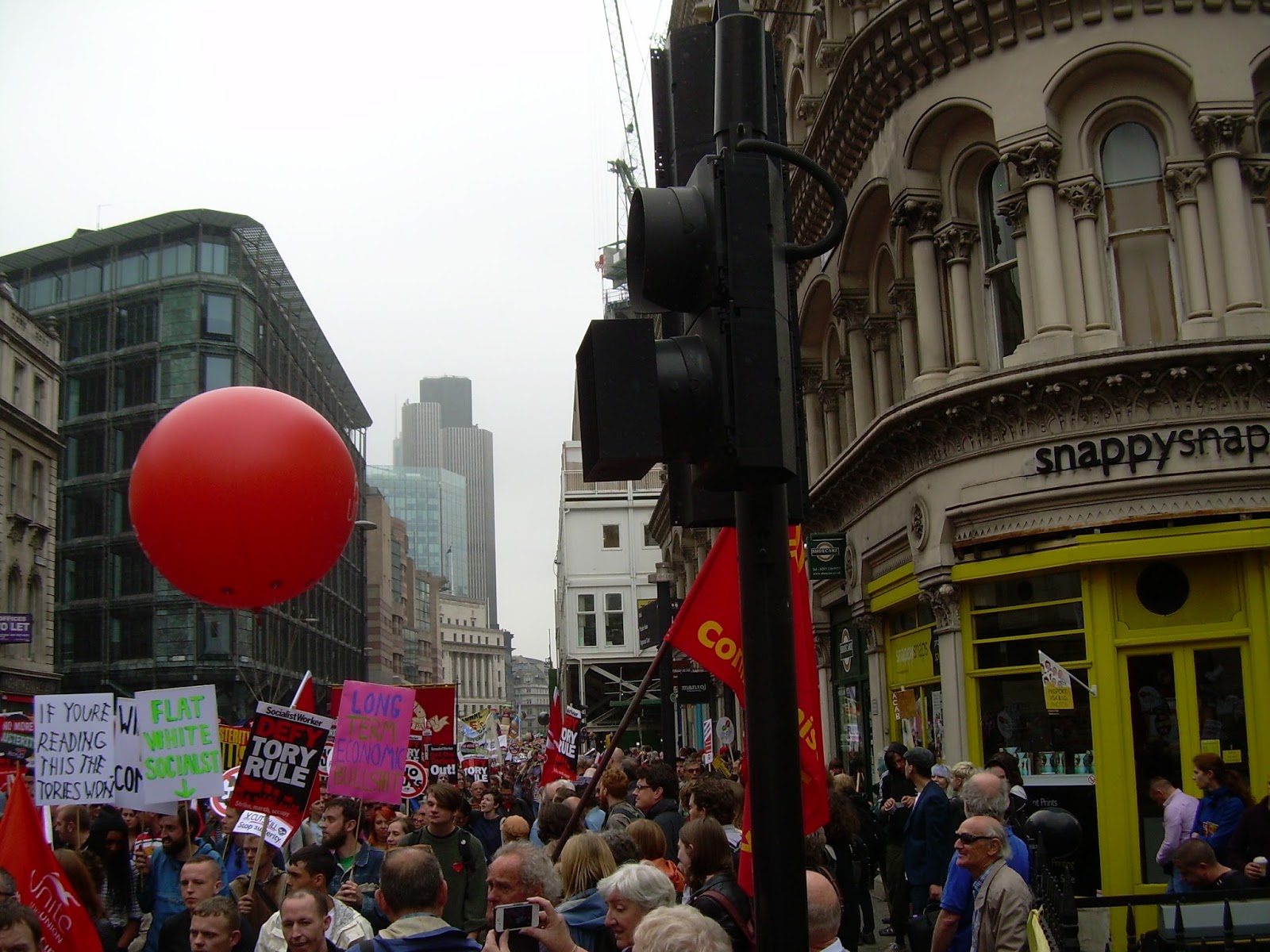
KOSHH campaigner, Colin Crilly, reports on the peaceful anti-austerity march held in London on Saturday 20 June:

The anti-austerity march in Central London was huge. Estimates of the number of people marching were as high as 200,000 in the media. Amongst these people, there was a high number of NHS campaigners.

KOSHH campaigners, Brian Hennessy, Saleh Mamon and myself represented our campaign. We took turns holding up the KOSHH banner throughout the march. We were able to link up with other NHS campaigners, such as the Lambeth Keep Our NHS Public group. During the march, prominent campaigner and editor of NHS SOS, Dr Jacky Davis took my photo.


 When I arrived at Parliament Square, I saw a fire engine. Sure enough, Steve, who let us use the fire engine for a protest in Sutton last year, was at the wheel. He sent his regards to all KOSHH campaigners and gave me his number in case we want to use the fire engine in future actions.

The rally had high profile speakers, including: Charlotte Church, Owen Jones, Caroline Lucas, Jeremy Corbyn and Russell Brand. At the finale, the crowd was encouraged to go into their communities to continue working hard and spreading the word.


Here are some more photos from the march.


On Wednesday July 8, there will be a further protest against an emergency budget from George Osborne - that is sure to bring more worrying news for our health services. Click here for more information.

Click here to order a copy of Dr Jacky Davis and Raymond Tallis's book, NHS SOS.

Sunday, 14 June 2015

Media coverage update: The latest on the Sutton Hospital site and Epsom-St Helier infection rates


This week, it was revealed in the Sutton Guardian that a planned school for the old Sutton Hospital site won't be built on the Sutton Hospital site. Instead, it is planned for Rose Hill. This seems to be in keeping with the "preferred option" as per the "traingate" leak for the Sutton Hospital site to be used for a new 800-bed hospital, at the expense of Epsom and St Helier Hospitals.

Click here to read the story.


It was also revealed this week that Epsom and St Helier Hospitals have not met infection targets. In 2014-15, there were seven cases of MRSA when the target was zero, and 42 cases of Clostridium Difficile (C-Diff), when the target was no more than 40. KOSHH does not believe that such figures should be used as stick with which to beat the hospitals and, thus, lead to demands for closures. However, it would be good to see figures on infection rates to see if the increase correlates with the use of private cleaning companies rather than NHS staff.

Click here to read the story.

Tuesday, 9 June 2015

We have a window poster!


If you'd like a window poster, please get in touch with us. You can tweet us at @Save_St_Helier or find us here on Facebook.

Welcome to the official online home of the KOSHH campaign


It has been a long time coming but at last it is here - the official blog of the Keep Our St Helier Hospital (KOSHH) campaign - the campaign to keep St Helier Hospital open with all its services intact. We also recognise the importance of keeping Epsom Hospital open. Our end of London and Surrey needs both hospitals to be run properly, funded properly and for both sites to receive much-needed upgrades to meet the needs of our communities in the 21st Century and beyond.

Our local hospitals are under threat again

We have fought many battles over the past few years and we thought we might get some rest when the Better Services, Better Values programme - which threatened services such as A&E, maternity and renal - was kicked into the long grass. How wrong we were. Just before the election, the now-infamous "traingate" leak happened - the BBC broke the story of consultants overheard on a train to Waterloo discussing plans to close Epsom and St Helier Hospitals and open a so-called "super hospital" at the site of the old Sutton Hospital. That would be the Sutton Hospital that has been gradually closing down in recent years.

But apart from ripping away two hospitals, strategically located to serve people in our area, the "super hospital" would not be so super at all. According to the leak, it would have 800 beds - a reduction in the number of beds for the area. We have no details on exactly what services would be on offer, whether these services would be publicly run or farmed out to private companies, how much this would all cost, how much has been spent on private consultancy firms already, and whether any costings have even begun to factor in things like the massive road and public transport upgrades that would be required for the Sutton proposal to become a reality.

We need to lobby the CCGs. But what are CCGs?

We met with the Epsom-St Helier Trust CEO, Daniel Elkeles, a few months ago in good faith. At no point was the Sutton proposal mentioned. We find it very hard to believe he wouldn't have known anything about it when we met with him. This is very disappointing indeed.

But it is the Clinical Commissioning Groups - known as CCGs - that hold the pursestrings. Ever since the Health and Social Care Act 2012 was passed at Westminster, these groups, made up of clinicians, are the ones making the big decisions about how our money is spent and how our health services are provided. These groups need to be lobbied hard and held accountable.

Neither our MPs, local councillors, the Health Secretary or Daniel Elkeles are in a position to guarantee the security of our services. This is why we urge MPs and local councillors to attend CCG meetings whenever they can, as well as members of the public.

Of course, finding the times of CCG meetings is difficult and this is something else that needs to be changed. What we do know is they are almost always held during office hours, which makes it hard for many people to attend. This also needs to change.

What do we want?

In light of the leak about a possible hospital on the Sutton site at the expense of Epsom and St Helier Hospitals, we need to know whether Sutton Council can dispose of this land for other purposes, such as education or affordable housing. This is urgent.

We are calling for proper investment in both Epsom and St Helier Hospitals so they can continue to provide the vital services we all depend on. Cutting vital services such as A&E, maternity, renal and the children's hospital will impact on us all and overburden St Georges Hospital in Tooting, a hospital that, like Epsom and St Helier, is doing great work but in very trying circumstances.

We want our money to be spent wisely. We are deeply concerned about the impact of outsourcing services, such as facilities management and non-emergency ambulances, to the private sector. The increased use of agency nurses - which costs a fortune - instead of properly employing nurses on a permanent basis is another serious issue that needs to be addressed.

We do not want our money wasted on yet another consultancy that is a re-run of Better Services, Better Value - only this time, entire hospital closures are the real risk.

The road ahead

We have a lot to do. We have a big fight ahead of us. This blog will be a place where you can find out more about the KOSHH campaign, ways you can help fight to keep our hospitals open and upcoming events. Feel free to comment at the end of the blog posts. We welcome open discussion.

KOSHH has members from a range of backgrounds, we are not a political party and we are not a front for any other political party.

Feel free to share this blog with family and friends. All posts are open to the public for comments. Constructive comments and debate are welcome.